Waldur is the enterprise catalogue and control plane for the VirtEngine market: publish IaaS, PaaS, SaaS and custom listings, order directly from chosen providers, and gate everything with approvals and compliance. VirtEngine turns each permitted order into a verifiable lease — escrowed, metered and settled on-chain.
The interactive order demo now lives where it belongs — on the marketplace hub. Browse the catalogue, configure a plan, buy direct, by bid or by selector, then deploy the lease and settle usage.
VirtEngine treats the chain as the marketplace source of truth. Waldur remains the provider-operated control plane for fulfilment and infrastructure operations. The provider daemon keeps the two correlated.
Verifiable market
VirtEngine Protocol
Consensus state: who may trade, what was agreed, what is owed, and what was settled.
providers ↔
offerings ↔
orders ↔
bids / matches ↔
leases ↔
VEID
escrow
settlement ↔
Consensus + market state
Bridge
Provider daemon
The operator-run agent that translates protocol events into control-plane operations and reconciles the answers back.
offering sync ↔
mapping
event subscriptions ↔
routing ↔
signed callbacks ↔
lifecycle reconciliation ↔
usage submission ↔
Translation + reconciliation
Control plane
Waldur
The service-management platform that presents the catalogue and operates resources, projects, quotas and reporting.
HomePort ↔
organisations
projects ↔
catalogue ↔
resources ↔
quotas
reporting ↔
backend plugins
Service management + fulfilment
Trace a responsibility: hover or focus offering sync to follow an on-chain
offering into the provider mapping and the Waldur catalogue; hover usage submission to follow
component measurements back through signed usage into settlement state.
Waldur is developed independently by the Waldur community and OpenNode Cloud. VirtEngine consumes its
public platform and client interfaces; it does not own or replace Waldur, and Waldur is not “running on
the blockchain”.
What users actually see
Waldur HomePort, area by area
Four interface areas, and the responsibility split inside each one. Screenshots are Waldur's own, reproduced with attribution.
Official Waldur screenshot · interface varies by release and deployment.
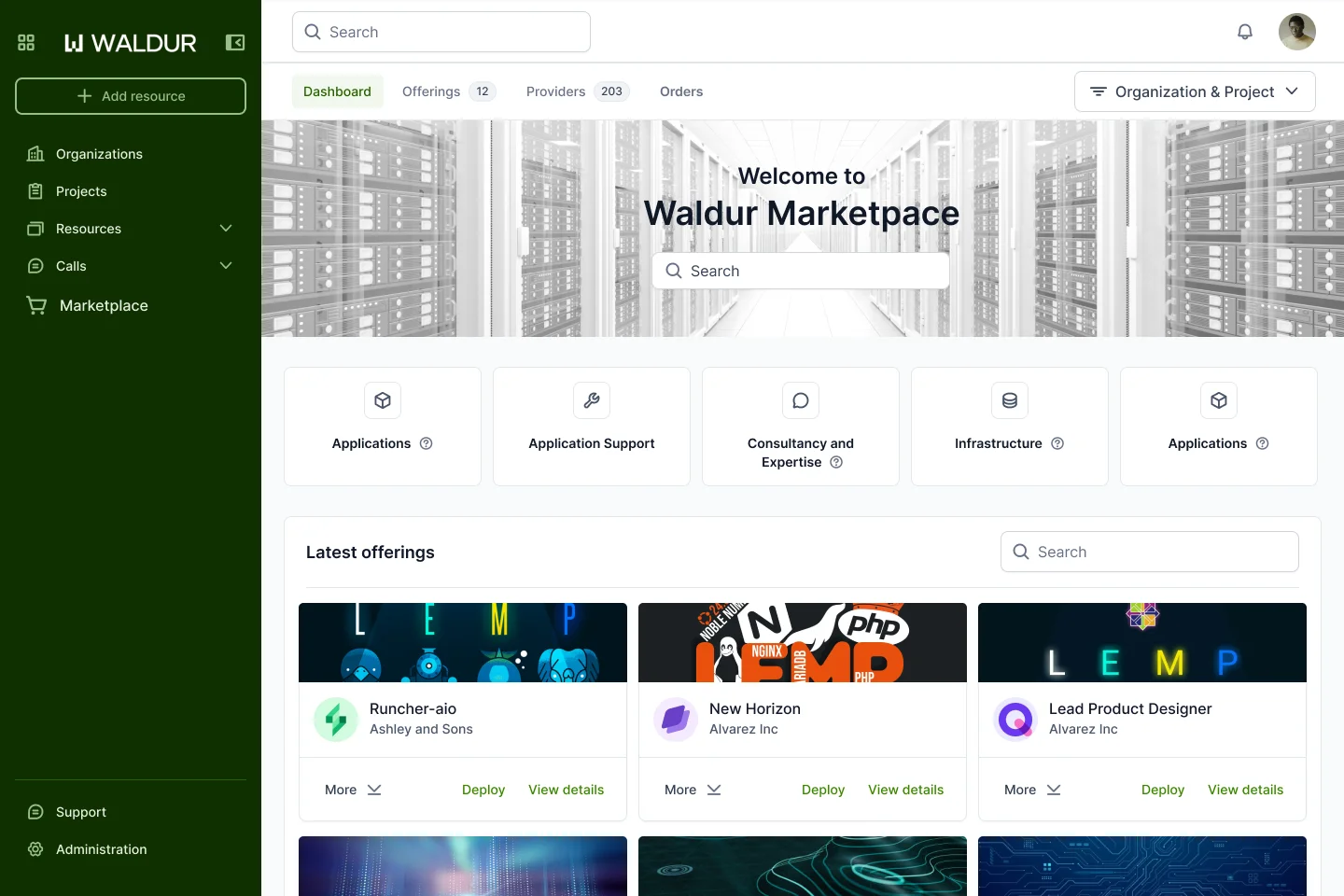
A searchable service catalogue
Categories, offerings and plans turn provider capacity into products. Users search, compare and order inside the same interface they use for everything else.
What Waldur owns
categories
offerings
plans
components
ordering UI
What VirtEngine adds
provider identity
on-chain offering reference
market matching
escrow-backed lease
Screenshot reproduced from Waldur's published material to explain the integration. View the official source ↗
Official Waldur screenshot · interface varies by release and deployment.
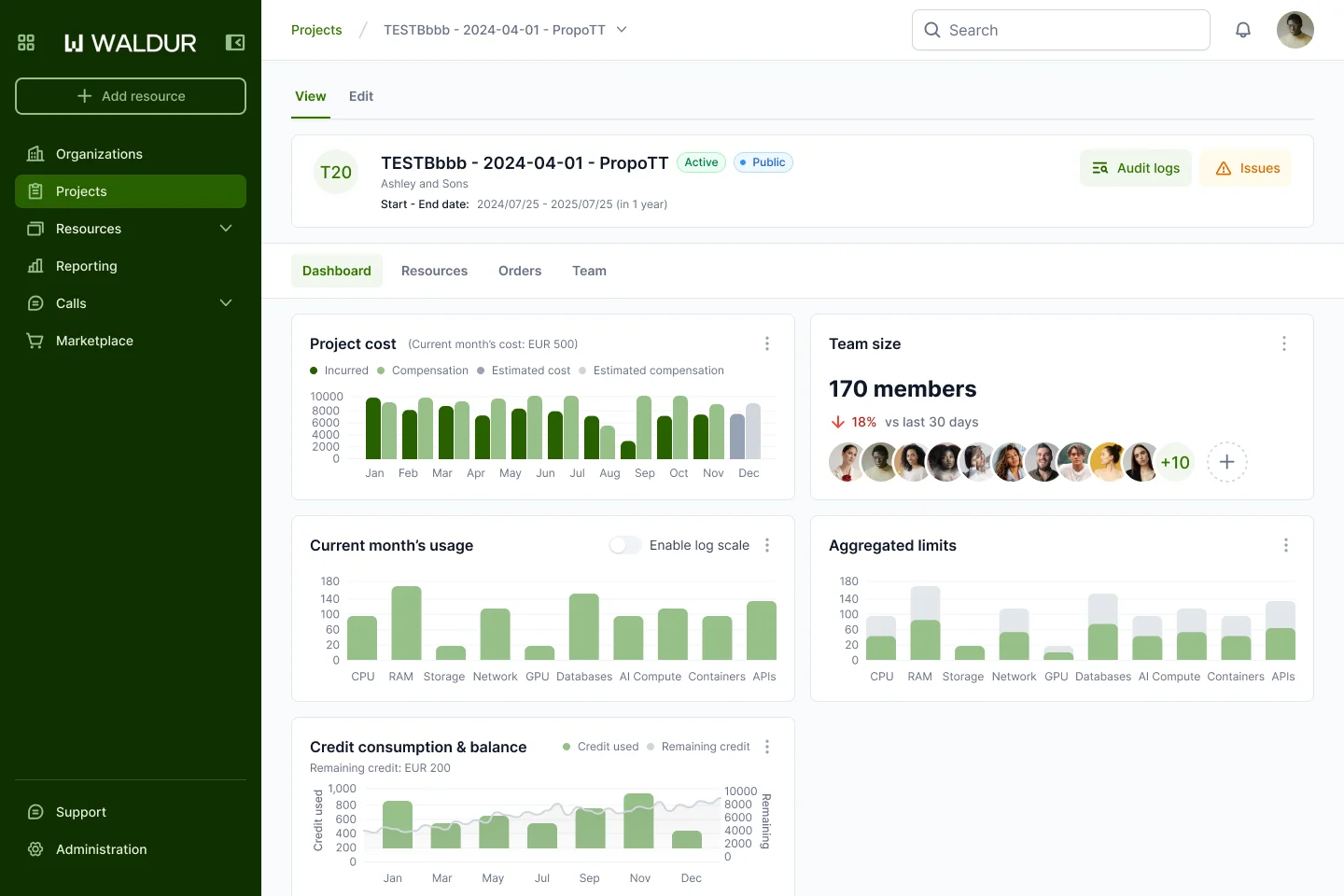
Projects group people, resources and cost
Organisations and projects carry membership, limits and cost views. Leased resources appear in the same workspace as the rest of a team's infrastructure.
What Waldur owns
organisations
projects
membership
quotas
cost views
What VirtEngine adds
lease correlation
counterparty identity
provider allocation visibility
Screenshot reproduced from Waldur's published material to explain the integration. View the official source ↗
Official Waldur screenshot · interface varies by release and deployment.
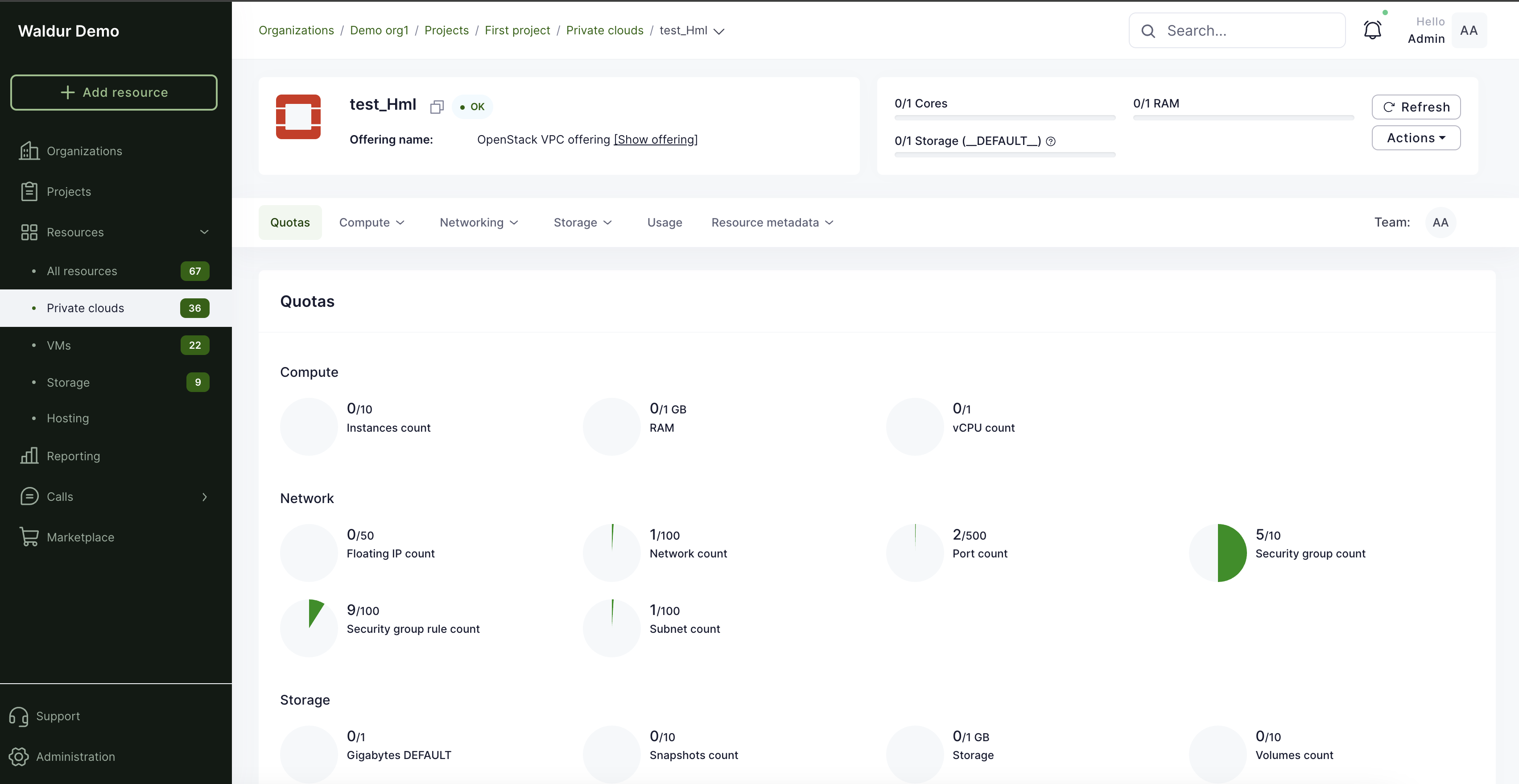
The provider-side operational console
Resource state, quotas and supported actions live in Waldur. Signed callbacks return lifecycle outcomes to the bridge, where they are validated and correlated.
What Waldur owns
provision
resize
suspend
resume
terminate
resource state
What VirtEngine adds
lease correlation
signed callback verification
protocol-state reconciliation
Screenshot reproduced from Waldur's published material to explain the integration. View the official source ↗
Official Waldur screenshot · interface varies by release and deployment.
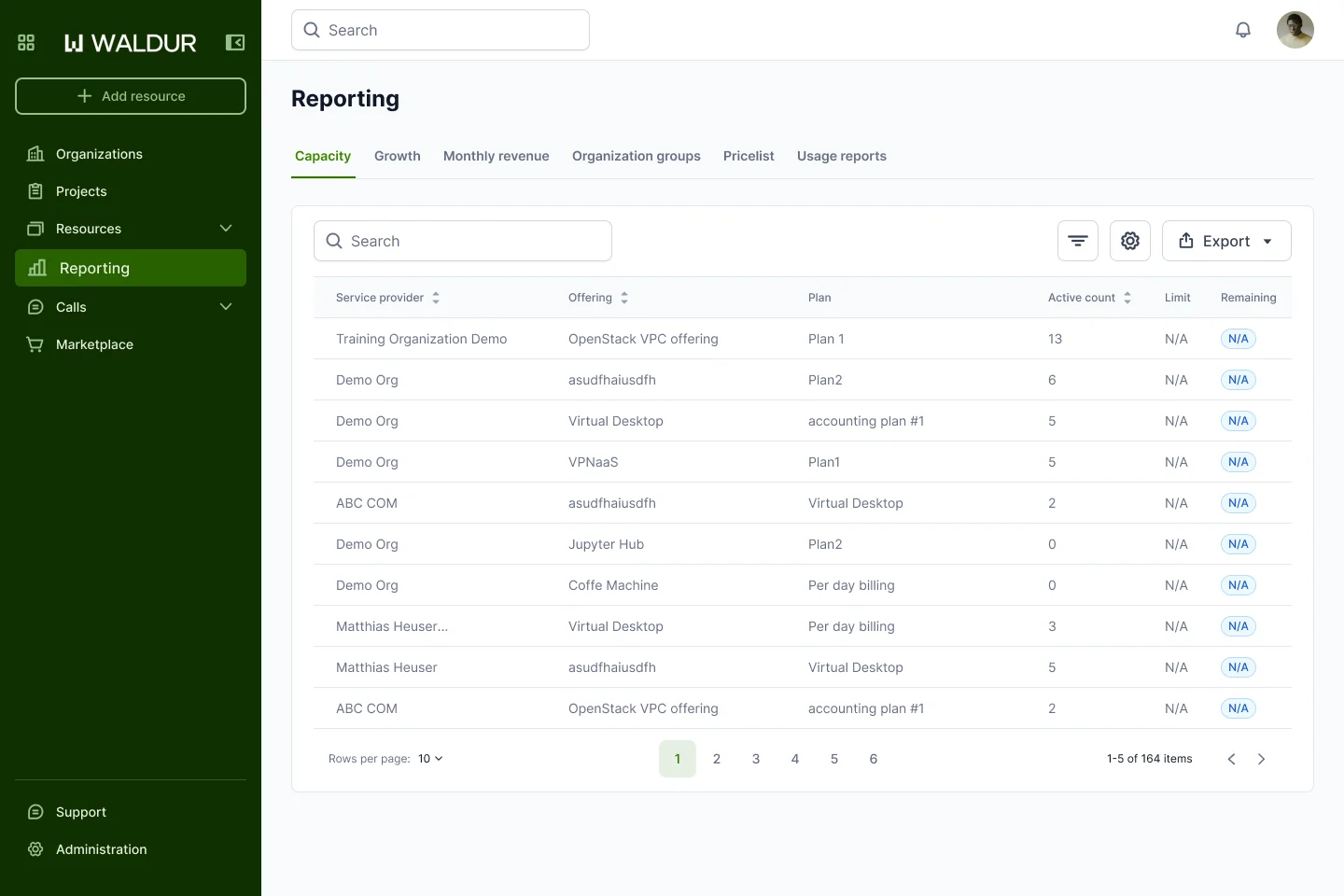
Operational and accounting views
Waldur exposes usage, estimates and accounting reports. VirtEngine separately turns signed usage records into protocol settlement against escrow.
What Waldur owns
usage views
accounting reports
provider reports
quota consumption
What VirtEngine adds
signed usage records
dispute window
escrow settlement
Screenshot reproduced from Waldur's published material to explain the integration. View the official source ↗
Walkthrough
Follow one order
A fictional Managed GPU Workspace, from publication to settlement. Illustrative example — no step implies live production availability.
The provider publishes the offering
A provider registers the offering on-chain and maps it into Waldur. The catalogue card and the protocol object stay connected by a persisted identifier.
Offering: Managed GPU Workspace
Backend: Rancher / Kubernetes
Region: ap-southeast
Components: GPU hours · CPU · RAM · storage
Illustrative example — Managed GPU Workspace.
PaaS
Illustrative example
Managed GPU Workspace
Example Provider
ap-southeast
1 × GPU
16 vCPU
64 GB RAM
1 TB storage
Billing components
GPU-hour
vCPU-hour
RAM GB-hour
storage GB-month
Component-priced plan
VirtEngine offering_id→chain object
Provider daemon mapping→persisted cross-reference
Waldur offering_uuid→catalogue item
It appears in the catalogue
The synced offering shows up as a catalogue card with its category, plan, region, components and provider details.
Category and plan are Waldur concepts
Provider identity and attributes come from the chain
Illustrative example — Managed GPU Workspace.
PaaS
Illustrative example
Managed GPU Workspace
Example Provider
ap-southeast
Plan: component-priced
Category: managed platforms
Provider verified
Component-priced plan
Order →
The tenant orders it
A direct order names the listing and matches at its published price. Escrow is funded before anything is provisioned.
Order summary is generated from the plan
No bidding window on a direct order
Illustrative example — Managed GPU Workspace.
ServiceManaged GPU Workspace
Regionap-southeast
ComponentsGPU-hour · vCPU-hour · RAM · storage
Escrowfunded against the order
The match becomes a lease
One tenant, one provider, one escrow account. The lease is the agreement every later step references.
Match selection happens on-chain
Escrow is locked against the lease
Illustrative example — Managed GPU Workspace.
01 Order
→
02 Match
→
03 Lease
→
04 Escrow locked
The lease binds tenant, provider and escrow account.
The provider fulfils the lease
The provider daemon routes the matched request into Waldur, which invokes the configured backend. The chain records the outcome; it does not create the resource.
Waldur order is correlated with the lease
Backend plugin creates the workspace
Illustrative example — Managed GPU Workspace.
01 Lease event
→
02 Provider daemon
→
03 Waldur order
→
04 Backend plugin
→
05 Resource
Fulfilment runs through the provider's control plane — not through consensus.
The resource becomes ready
Resource state moves through the provider's control plane and returns as an authenticated lifecycle callback.
Provisioning → Ready
Signed callbacks keep lease and resource correlated
Illustrative example — Managed GPU Workspace.
Resource statusProvisioning→Ready
Components are metered
The provider daemon meters consumption per workload on a scheduled cadence and submits signed records against the lease.
GPU hours, CPU, RAM and storage are separate components
Anomaly screening runs before submission
Illustrative example — Managed GPU Workspace.
GPU hours12.4 h
vCPU hours198 h
RAM GB-hours792 GB-h
Storage GB-months0.41 GB-mo
Illustrative meter readings — not production data.
Validated usage releases escrow
After the dispute window, validated records price into line items and the agreed amount releases from escrow to the provider.
Unspent escrow returns to the tenant
Waldur reporting remains an operational view
Illustrative example — Managed GPU Workspace.
01 Signed usage
→
02 Validation & dispute window
→
03 Settlement
→
04 Escrow release
Waldur reporting stays operational; the protocol payout follows the lease.
Catalogue
Fulfilled here, explained there.
Waldur fulfils IaaS, PaaS, SaaS and custom listings — the catalogue itself is owned by the marketplace hub. Direct ordering is what this catalogue fulfils end to end; open bids and selector matching are chain-side paths covered in the buying guide.
Waldur's catalogue controls decide which providers your teams can even see — the chain then records and settles whatever those controls permit.
Catalogue scoping
Private offerings and limited plans
Providers can publish private offerings visible only to chosen customers, limit plans to specific organization groups, and restrict ordering to named project roles. What your teams can't see, they can't order.
Dual approval
Consumer and provider gates
Every order passes two independent approvals: your side (consumer review, cost limits, purchase-order attachments) and the provider's side. Either side can require manual sign-off.
Terms and compliance
Contracts accepted per order
Each offering carries its own terms of service, privacy policy and access policies, re-accepted whenever they change. Providers attach compliance checklists your teams answer and auditors can inspect.
Counterparty choice
Clear requirements before matching
Providers must clear VEID identity verification, minimum trust scores and compliance checks before they can publish; offerings can additionally demand score thresholds and multi-factor authentication from buyers.
A note on SLAs and liability, stated plainly: there is no on-chain SLA object, and the protocol cannot
underwrite a provider's uptime. Commercial terms live where contracts live — in offering terms, descriptions
and plans, accepted per order — while the chain independently verifies what money can verify: gated
counterparties before matching, signed metering during service, escrowed funds, and rule-bound settlement.
Legal liability stays with the provider organisations you chose; the protocol makes their performance
auditable.
Integration status
Implemented code, and what deployment still requires
An upstream Waldur connector is not automatically a production-ready VirtEngine integration.
Present in the VirtEngine integration code
Real code paths in the repository — not a design-only diagram.
Waldur API client
offering operations
offering synchronisation
order routing
resource lifecycle handling
callback verification
usage submission
provider-daemon integration
Requires provider / operator deployment
Production availability depends on operator configuration and certification.
Waldur installation
credentials and organisation IDs
organisations and projects
category mappings
backend plugin
TLS and callback configuration
durable chain submission
production certification
infrastructure-specific configuration
“Implemented” means a code path exists in the repository; production availability still depends on provider
configuration, credentials, backend compatibility and deployment certification. This status reflects the
current repository and published Waldur documentation.
Available in Waldur upstream
Cloud and cluster providersWaldur documents OpenStack, Rancher, Kubernetes, VMware, Azure, DigitalOcean, SLURM, MOAB and other provider modules.
OpenNebula site agentWaldur already documents an OpenNebula site-agent plugin; VirtEngine's first-class chain mapping is still planned.
Federation and identityDocumented options include eduGAIN, eduTEAMS, Keycloak, LDAP, FreeIPA, MyAccessID and TARA.
ExtensibilityRemote offerings, custom scripts, OpenPortal and site-agent plugins provide routes for operator-specific services.
VirtEngine roadmap
Proxmox VEA planned provider adapter and catalogue route. It is not presented here as a shipped Waldur or VirtEngine integration.
OpenNebulaA planned first-class VirtEngine bridge using Waldur's existing site-agent capability, with lifecycle and usage mapped to chain state.
Production certificationEach enabled backend still needs versioned profiles, end-to-end provisioning evidence, cleanup, quota and cost-control testing.
Project stewardship
Developed and stewarded by OpenNode Cloud
OpenNode Cloud leads Waldur development, support and deployment services. Waldur is open source and is co-developed with the University of Tartu. VirtEngine consumes the public platform and client interfaces; it does not claim ownership of Waldur.